
![]() |
![]() |
| home | contact us | about us | site map |
| Press and Reviews | <back | |||||||||||||||||||||
|
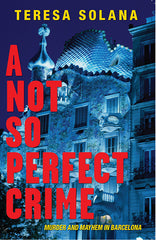
A Not So Perfect Crime by Teresa Solana5 Exotic Detectives in a Crime Roundup 'Perfect summer reading – indeed, thoroughly enjoyable at any time – is this ironic crime caper set in present-day Barcelona and written by a Catalan author. If you don't associate Catalan with capers, think again. The hook here is to have a pair of non-identical twins set themselves up as so-called detectives, working purely for the rich and famous seeking discretion. Clients who want discretion won't make a fuss, and if they're rich they should pay up. Not that our sleuths give poor value. They may be amateur but they do try. Engaged by a rising politician to check on his wife's fidelity, their case quickly becomes one of murder, by poisoned sweeties. Their quest takes them into Barcelona's highest echelons (amusingly set against the narrator's more humble family life) and on to an expenses-paid jaunt to Paris (found less than amusing by the narrator's wife, who is left at home). This highly agreeable novel ends unexpectedly, on a surprisingly contemplative note.' - Crime Time DEAD AFTER EATING A POISONED MARRON GLACÉ ‘Teresa Solana has a degree in Philosophy from the University of Barcelona where she also studied Classics. This, her first published novel, won the 2007 Brigada 21 Prize for the best crime novel written in Catalan and has been translated into several languages, this version by Peter Bush. It’s a very funny, rather endearing story of the blundering attempts of twin brothers Eduard and Borja to investigate politician Lluis Font’s beautiful wife whom her husband suspects of infidelity. There are many obstacles to the success of their mission, such as their own impecunious state, Eduard’s demanding wife and family, Borja’s very dodgy false persona and lastly the murder of the politician’s wife with a poisoned marron glace from a box of sweets delivered anonymously to her home. This very well written caricature of Catalan politics will keep the reader guessing right up to the very end.’ - reFresh Magazine ‘When visiting somewhere new, I always like to seize the chance, if possible, to read a book set there. So my trip to Barcelona offered the ideal opportunity to sample a debut novel by a Spanish academic, Teresa Solana, called A Not So Perfect Crime. It’s just published by Bitter Lemon, who have made available some quite splendid books not previously available in English translation. The novel is told by Eduard, one of two twin brothers, who run a detective agency together. In fact, it’s more or less a phoney operation, since neither of them is much good as a detective, and they invent a secretary to impress clients, spraying perfume around in their little office before pretending the girl has gone off on an errand. The office even has false doors leading nowhere, to give a grand impression to visitors. When a top Catalan politician asks them to investigate whether his gorgeous wife is having an affair with a painter for whom she has apparently modelled. The shameless Borja, much the more entrepreneurial of the twins, extracts large sums of money from the client for doing very little, but when the wife ends up dead, our heroes find they may have bitten off more than they can chew. This is a funny and enjoyable novel, and I was amused by the coincidence that one scene of the book took place in a café where we’d had lunch twenty-four hours earlier. The twins are a memorable duo and there are some laugh-aloud scenes. The element of the book that satirises Catalan politics rather passed me by, but this didn’t spoil the fun. The zany plot is a mess – but, to some extent, that is the point: this is a sort of ‘anti-detective’ novel. If Solana brings the twins back, she will almost certainly have to treat the story-line more seriously, but I hope this doesn’t deter her from a follow-up. Such good characters deserve to live again.’ - www.martinedwardsbooks.com ‘So what is it about Barcelona, anyway? Solana’s acidly funny mystery lifts the lid on the Catalan capital in a plot that involves a seedy politician, the wife he suspects of infidelity and who ends up murdered, and two privately hired detectives, the twins Eduard and Pep, who boast that they help the rich and famous with their ‘dirty laundry’. The twins’ office has false doors leading to non-existent rooms, a mysterious secretary who is always absent, and a clapped out laptop. Be puzzled, but ultimately entertained.’ - Spain ‘The city of Barcelona, and the awkward class divisions of Catalan Spain, are the themes of this unusual murder mystery. The secret relationship of the twin private detectives is used to set up humorous situations, but Solana also uses it to highlight social behavior...She paints a glorious picture of an urbane and lubricious Hispanic lifestyle as the brothers gumshoe their way through cocktail bars and tapas joints... The portrayal of winter life in Barcelona is lively and the relationship between the two brothers is fascinating...' - Times Literary Supplement ‘Murder and mayhem in Barcelona’ is an understatement. Teresa Solana’s book A Not So Perfect Crime may be full of murder and mayhem, but it’s also packed full of humour, acute observation, a complicated plot, and downright ridiculousness. ‘Do most readers look at reviews or blurbs or the descriptive copy on the back of a paperback (or the inside of the dustcover of a hardback) before starting to read a book? I try not to, because I like to be surprised, and I like to discover the characters in the midst of their own world rather than in the "outside world" of a reviewer's (or a book promoter's) notion of who they are. I didn't read much about Teresa Solana's newly translated (from the Catalan, by Peter Bush) before I read the novel, but I found myself looking at reviews after I finished reading it (something I usually don't do until I've given some thought to what I might say about the book in a review myself): A Not So Perfect Crime does not fit neatly into any category of crime fiction, and the particular pleasures of reading the book are not easy to describe or to pin down. At one level, the book is a lot of fun, with some very telling Hitchcock references, for example, and in numerous passages, Solana gives a very palpable sense of walking through Barcelona and walking into various kinds of uniquely Barcelona rooms and buildings. Solana's book is on the one hand a straightforward detective story, of the inexperienced-detective-in-over-his-head type. Eduard and his fraternal twin brother Pep (who adopted a new identity under the name Borja) have struggled into middle age, each in a different way, Eduard (the narrator) leading a conventional office-worker's life with wife and family and not quite getting to the end of the month on their paychecks; Borja arriveing in the novel's present and back in Barcelona after a more bohemian life traveling around Europe and the world. Borja has convinced Eduard to both keep concealed the fact that they're brothers and join with him in an unincorporated, unlicensed business specializing in discreet investigations. What follows is an intriguing satire of Barcelona society and politics, as well as a serio-comic crime story leading from a politician suspicious of his wife to murder and an unlikely and unconventional success in solving the puzzle of the crime. But what pulls the reader forward isn't the puzzle: Eduard and Borja (plus Eduard's wife Montse, Borja's romantic attachments, and various characters from Catalan high and low society) are great company, and the writing is lucid and impeccable--and Eduard's voice as narrator is that of an ordinary guy who's gotten himself into a situation he can't control. There is a farce lurking in the plot but Solana doesn't foreground it in the way that Ottavio Cappellani does in his Sicilian Tragedee; Solana's switched paintings, blackmailed politicians, and hidden identities remain tantalizingly under control, subservient to an almost matter-of-fact, naturalistic style. The central characters are in some senses right out of the hard-boiled detective playbook, but they turn out to be fascinatingly normal, three dimensional rather than clichéd. And the jealousies, strategies, and crimes are the stuff of daily life and conflicting social class rather than the overheated stuff of serial killers or international conspiracies: Solana's writing is cool and straightforward and her plotting and characters are right off the ordinary streets, schools, political offices, and new-age clinics of a contemporary city (albeit a unique and fascinating one). Some of the elements of farce do resolve themselves in subtle comedy, and others remain cloaked in secrecy: did Borja change his name only to masquerade as aristocracy (there seems to be more to it than that); why does Borja refuse to let Eduard tell even his wife that they're related? Such basic conundrums suggest the beginning of a series (which I'd wholeheartedly welcome), in which the mysteries would play a part (or find a solution), but they also give the novel as it stands a depth beyond its glimmering surface. A Sicilan Tragedee is a laugh-out-loud comedy of modern but murderous manners; A Not So Perfect Crime is a wry, subtle comedy of satire and character, that also manages to be a noir crime novel that comments on the mores and morals of 21st century Spain. Solana's book is a great complement to the other outstanding Barcelona crime novels that have been translated, from Manuel Vázquez Montalbán and Alicia Gimenez-Bartlett (who both write in Spanish) to Maria Antonia Oliver (who like Solana writes in Catalan, but whose only Barcelona mystery to be translated is Study in Lilac). More of Vázquez Montalbán has just come out in English from Serpent's Tail, and Europa Editions has been steadily adding to the Gimenez-Bartlett novels available in English, and now Bitter Lemon has given us Teresa Solana's first book. Can we hope for more from Barcelona, from these and other writers?’ - International Noir Fiction ‘This first novel (the author says she wrote several previously but relegated them to a drawer) introduces twin brothers scrounging for a livelihood in Barcelona. One is a part-time accountant in a bank, the other away for many years before returning with a different name to convince his brother to undertake a business of facilitating tasks for influential people who wish to bury their "dirty laundry." They are not investigators by any means but end up conducting a job for an influential politician who suspects his wife of infidelity. One thing leads to another as the brothers con their client about their various discoveries until the wife suddenly dies of poisoning. The politician implores them to uncover the identity of the murderer since the husband is one of the potential suspects. They bumble around until they end up finding an unusual solution to all the problems. ‘A Not So Perfect Crime introduces an appealing investigating duo, the twin brothers Eduard and Borja. The gag is that no one knows they are brothers , and while Eduard, who narrates the book, has remained fairly true to himself, Borja has completely reinvented himself, moving comfortably in high society circles even as he is a complete (but very charming) fraud. The brothers have formed a sort of consultancy -- Frau Consultants, Ltd. (the name they chose was 'Tau', but the printer messed up ...) -- where they discreetly handle matters for well-heeled clients. And the two brothers each have their distinct roles. As Eduard explains: In terms of hierarchy, he's the company director and I'm his deputy. In practice, to make it crystal-clear, he provides the clients, class and personal charm, and I perform the bloodhound routines. It's mostly just an act, from the fact that the company isn't even registered to the offices they use, complete with secretary who conveniently is always elsewhere. Still, they attract some clients -- and they seem to have landed a big fish when MP Lluís Font engages them. He's found a painting for which his wife apparently posed, and he's worried that she is having an affair with the painter. The brothers soon find themselves in rather over their heads when the wife turns up murdered, the MP turns out to be having his own affair, and they switch the controversial painting with one Eduard's mother-in-law painted. Eduard's family life suffers some from the demands the case places on him -- though it is Borja's flings that are more problematic -- and Solana makes a good deal out of the two very different brothers and the clash of personalities, especially as Borja's style digs them in deeper -- and also helps dig them out. Solana is presenting a class-portrait here, as there's a divide in Barcelona (and Spanish) society that is felt at nearly every turn. It all moves at a very leisurely pace -- tailing the wife means following her every boring move, and Solana does not spare the reader -- but with enough odd variety -- a side-trip to Paris, where the mystery of the painting is cleared up, the sudden appearance of the MP's lover -- to keep things interesting. A Not So Perfect Crime also has a fairly agreeable resolution, with most of the answers (including whodunnit) but also a certain untidiness that fits with Borja's general attitude. Still, it does all feel a bit forced, Solana inspired by a good premise -- the mismatched brothers that no one knows are related and their business, with little to sell except discretion (professional PIs they ain't) -- and a decent idea for a murder-plot which she then had to write a novel around. There's too much padding, and while the class dimension is entertaining (and central), she works it very hard. Still, it feels like the promising beginning of a series, the basic set-up ripe with potential and stuck-up Barcelona society ripe for the picking.’ - Complete review ‘Solana’s sparkling debut pokes sharp fun at Catalan politics, society and pretensions. Despite different names and personalities, Eduard Martínez and Borja Masdéu are not only twins but partners in Frau Consultants, an extralegal outfit that provides discreet services to Barcelona’s well-to-do. Lluís Font, a powerful MP with presidential ambitions, hires the brothers to determine if his wife, Lídia, is having an affair with the painter of her portrait. That assignment is right up their alley, but when Lídia is poisoned via a gift box of marrons glacés, the brothers are out of their depth. Borja, who’s remade himself as a member of the upper class, is a confident and amusing operator, while brother Eduard is a family man with scruples and misgivings. From their false front of an office and the secretary who exists only as a lingering scent and a bottle of nail varnish, the brothers bumble and stumble to the truth and hopefully to further adventures.’ - Publishers Weekly ‘Barcelona features again (this time in an unmistakably 21st-century setting) in Teresa Solana's thriller, which – uncannily – also involves a side-trip to Amsterdam. A politician suspects his wife of infidelity, but the twin private eyes he calls on to investigate find themselves involved in a murder hunt when the errant wife is poisoned. Lots of local colour, plenty of confusion between the twins and some satisfying plot twists lead to a cleverly plotted outcome.’ - Scotsman ‘Solana’s excellent debut novel, set in the streets and parlors of Barcelona, offers both probing social commentary and an excellent crime story. Twins Eduard and Borja (except no one knows they are brothers) run an off-the-books investigative agency, and they think they’ve have landed a big fish when a famous MP contacts them, suspecting his wife of infidelity. What seems like a run-of-the-mill crime in upper-class Barcelona becomes much more complicated when the lady in question is found dead of poison on Christmas Day. Despite the leisurely investigative style of the brothers, the story moves along quickly, carried by the excellently paced plot, the fascinating details of daily life in Barcelona, and the myriad fascinating characters, from Eduard’s alternative-lifestyle guru wife, to Borja’s high-society “aunt.” Suggest this one to readers who have enjoyed Chris Ewan’s Good Thief series (Good Thief’s Guide to Paris, 2008).’ - Booklist ‘Teresa Solana’s A NOT SO PERFECT CRIME is another translated treat from the fine folks at Bitter Lemon Press. The setting is lovely and warm Barcelona, which just makes you want to hop on a plane and visit once you’re finished reading. The story deals with twin brothers who are now detectives, with their training being reading mysteries as children and watching all the episodes of COLUMBO. ‘On first look, one would not consider them brothers; on meeting them one would notice how their personalities are total opposites; their differing surname support the assertion that the pair does not share the same DNA. However, Eduard Martinez and Borja “Pep” Masdeu are not just siblings, they are twins. In Barcelona, the pair open up Frau (as in Tau as you get what you pay for especially the poor) Consultants providing special (some might insists illegal or least Borja has a tendency to cross the line) circumspect services to the rich and richer though they hide their common heritage even from Eduard’s wife. MP Luis Font plans to run for president, but cannot afford personal scandal. He hires Frau Consultants to discreetly investigate his wife Lidia to insure she is not cheating on him with the portrait artist painting her. However, someone sends Lidia a gift of marrons glaces flavored with poison. When she dies the brothers investigate her murder fearing their client did it and might be setting them up for the fall. The fun in this satirical whodunit is the fumbling twins who thrive on making mistakes while putting up a false bravado façade even when it comes to their office. The story line converges on the political-affluence connection, but is owned by the soft-boiled siblings as they hide their DNA link (never quite explained why) and their clueless skills while working on ‘A Not So Perfect Crime’. - Mystery Gazette ‘We're not currently over-run with crime novels translated from the Spanish. And if A NOT SO PERFECT CRIME is anything to go by, someone should go and remedy this soon as they like.
|
|||||||||||||||||||||
| <back | ||||||||||||||||||||||
| © Bitter Lemon Press |